
Hammer and Nail

A note on product innovation and need discovery: find the problem first, then align the solution to it.
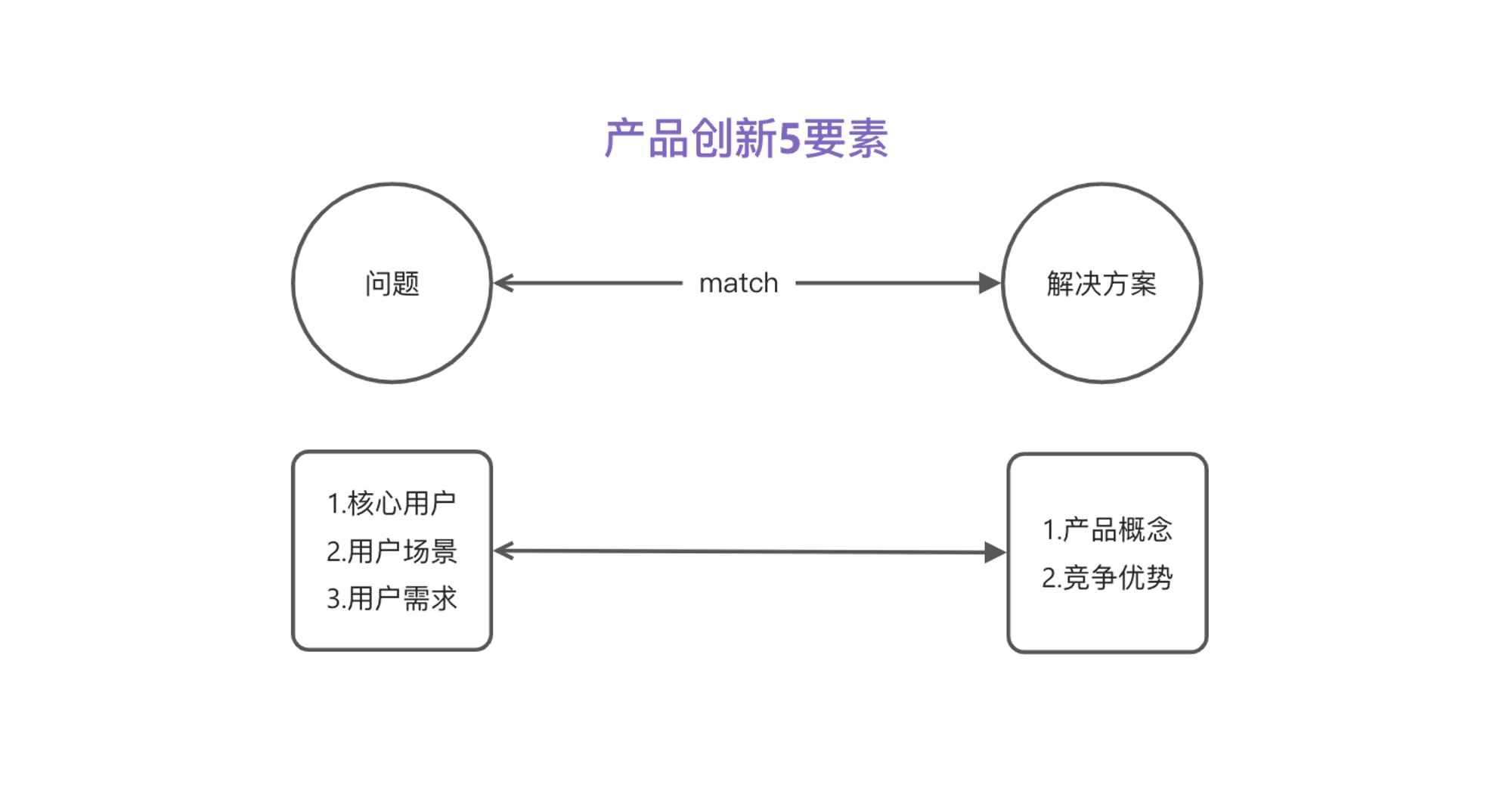
Five Elements of Product Innovation
Problems
Whose problem is it? (Typical user)
In what situation does the problem appear? (Typical scenario)
The need itself (a must-have need)
Solutions
Product concept (a one-sentence statement from the user's perspective)
Dedao is an app that lets you understand a book in 20 to 30 minutes.
Competitive advantage (compared with current competitors)
Product Innovation Process
Product innovation is the process of matching a problem with a solution.
You can start from user pain points or from technology, but the end point still has to be a specific user and scenario.
The goal is to find PMF. You can adjust the technology, the market/users, or both.
Start from technology, then adjust the market
Ali's "Laiwang" was initially positioned against WeChat, but it did not gain market share quickly. The market was then adjusted, and the same underlying technology and architecture became DingTalk for small and medium business office scenarios, which succeeded.
There is also a method for finding a nail with a hammer (for example, finding use cases for AR technology):
List the scenarios in a day from morning to night (brainstorm).
Study the market size and user pain points for each scenario.
Build a low-cost demo, get feedback, and keep iterating until you find the right nail (prototype, test, learn, iterate).
How to Identify User Needs
Television (you think you'll use it, but you don't) vs. dishwasher (you never expected it, but it turns out to be great)
Users are not good at proposing solutions (they may not even know what they haven't thought of), but they can state needs if you ask carefully.
Users may not be able to directly articulate pain points, or many pain points may already be solved.
Proposal: use high-density, low-cost user research to keep learning the user's mental model, instead of doing one-off research just to test a task.
Example: work for a Taobao boss for a week and discover that, as a new parent, you cannot balance response time very well (similar to contextual inquiry or walk-a-mile immersion).
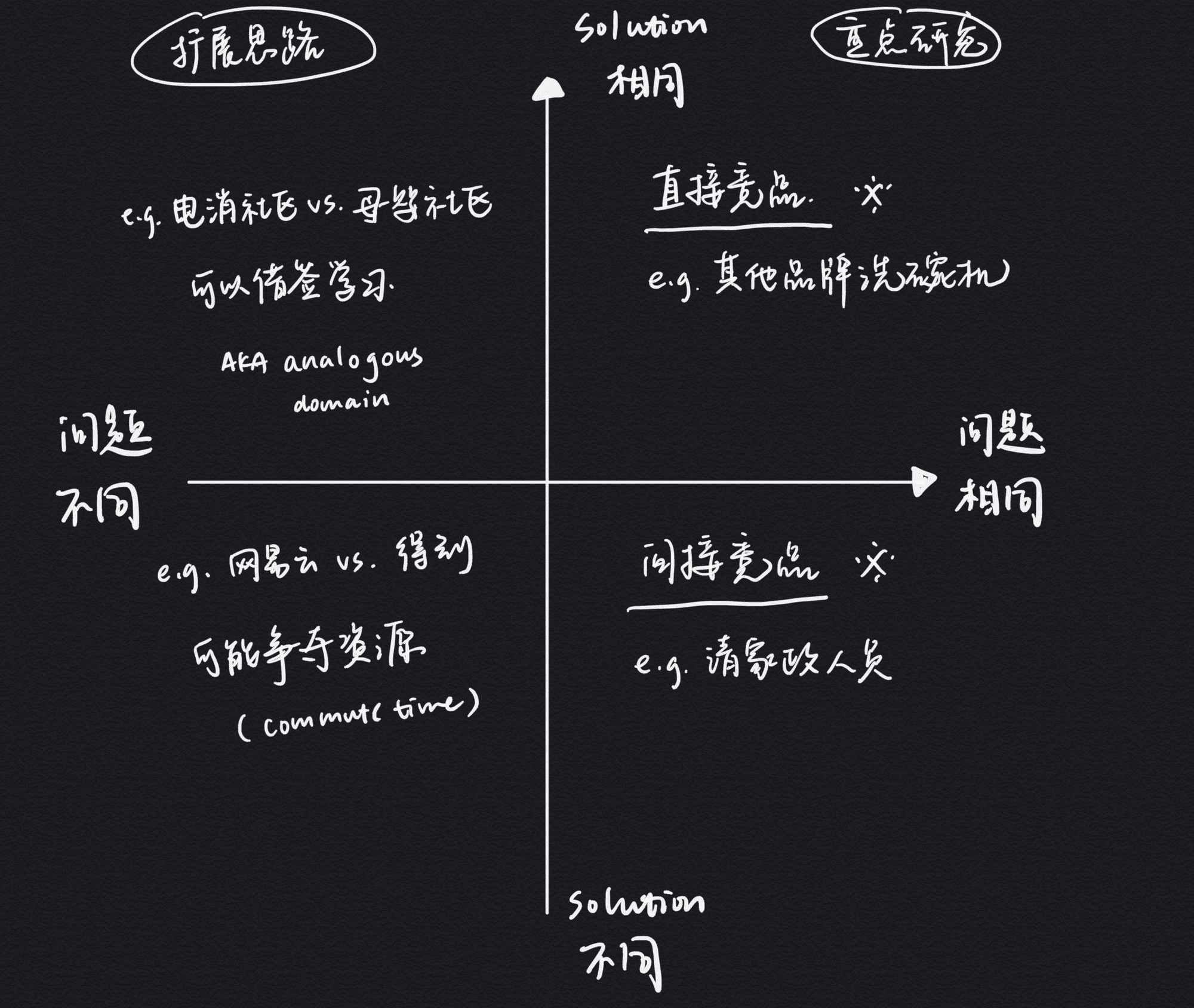
The Full Dimensions of Competitive Analysis
The main focus is still on direct and indirect competitors (substitutes); the other two quadrants can provide new ideas.
5MVVP
Viable on the technology side and valuable on the market side.
Paperwork (concept screening)
Prototype (prototype testing)
Product (productization)
Promotion (scaled promotion)
Portfolio (turn a single product into a product portfolio to improve competitiveness)