
The Method of Communication

From listening and recognizing communication patterns to responding proactively, a practical guide to more effective collaboration at work.
Background
This article comes from a team sharing session in mid-2023. For someone just starting a full-time job, building remote communication skills, basically typing every day, felt very valuable for my future career growth. It may not be obvious right away, but as Flomo says, keep recording and the meaning will emerge. Below is the prepared talk:
In last year's year-end review, I said I wanted to improve my communication skills and willingness to share in 2023. I chose The Method of Communication as my reading material, and today I want to share some of my reflections.
👀 I believe most of the techniques in the book are already familiar to people to some extent. Many of them are used at work too, but few people have fully summarized these small experiences.
Part 1: Start with Listening
"The biggest problem with communication is the illusion that it has taken place." — George Bernard Shaw
How do you catch the key points when listening to someone?
Emotion: you can often sense emotion from someone's tone of voice. In text conversations, you can also infer it from how they write.
Facts: use the 4Ws to reconstruct the situation (who, when, where, what).
Expectation: identify what the other person actually wants.
Respond to emotion: name it and accept it
Confirm the facts
Clarify the next action
Part 2: Listen Between the Lines
💡 Listening goes both ways. It is important to understand what the other person means, and it is also important to show them that you understood, so they feel in control and both sides can reach a shared understanding.
Communication Styles
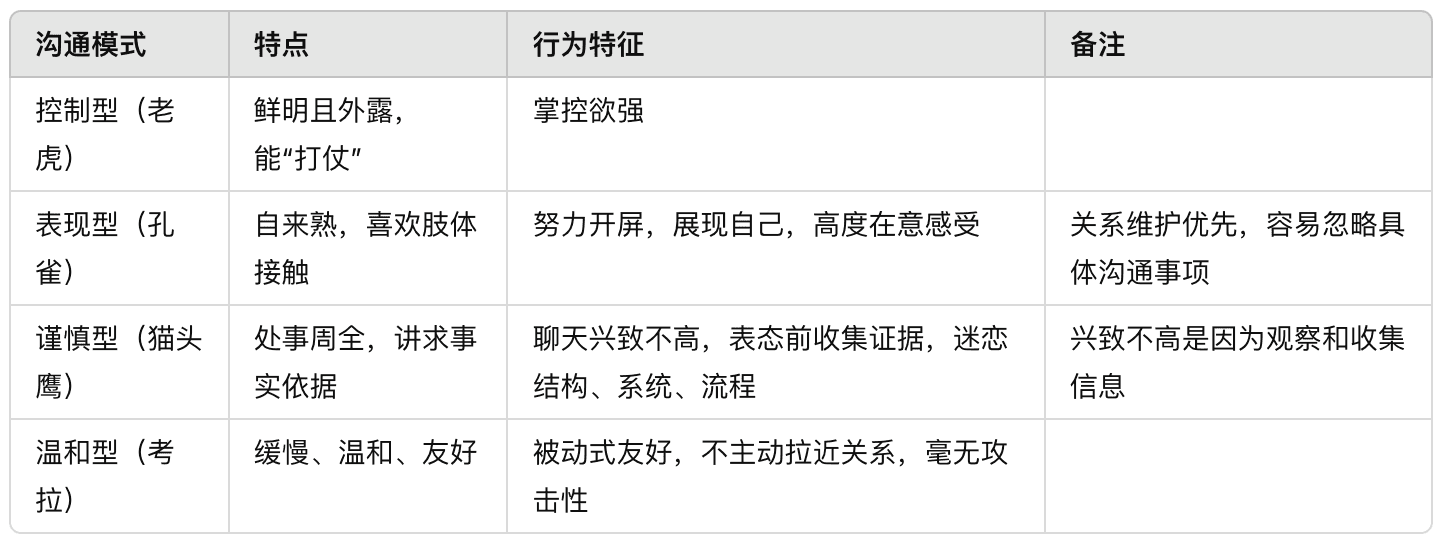
How to identify them
Different communication styles are evenly distributed. In any communication setting, we may meet all kinds of people.
Conflicts between different communication styles are "inevitable".
How to communicate with different styles
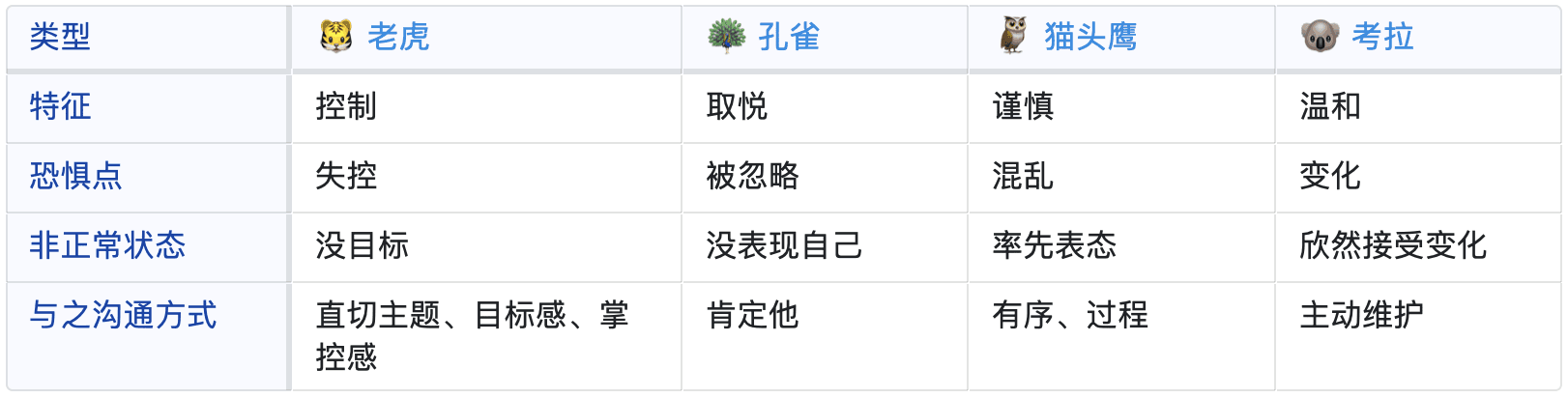
How to communicate with hybrid types
Peacock + Tiger: give the other person both a sense of control and a chance to express themselves.
Peacock + Koala: praise them and give them a sense of order.
Tiger + Owl: care about both goals and process, follow the plan closely, and avoid mistakes.
💡 When we can play a role very different from ourselves for a communication task, our communication ability improves significantly. Part 3: Proactive Responses
A closed loop for listening
Build an information-processing framework: understand what the other person means (structured listening), hear the hidden story (reading between the lines), and confirm effectively so they know we truly understood (reverse narration).
Assumption: the other person is friendly and well-intentioned, you are capable of handling the issue, and both sides are working toward solving the problem together.
Life and work scenarios
The other person may not be communicating with good intentions.
The other person brings up a request I do not want to agree to.
The other person asks a question I do not know how to answer, or a question I do not want to answer.
We should try to respond positively and kindly to any question, but how do we do that in an unfriendly communication climate?
How to respond positively in an unfriendly communication climate? — the substitution method
Change the framing
The other person is unfriendly and speaks in a sarcastic or passive-aggressive way.
You want to end the conversation quickly.
Change the timing:
You need to change the pace of the conversation and pause to get some breathing room.
In the moment, it is hard to fully understand the other person's intent.
Change the setting:
A case where you need to push back on a leader in an in-person meeting (de-escalation).
Coordinate cross-team resources and report upward (escalation).
Change the role:
When you encounter something you cannot judge yourself.
When the question is inconvenient or you do not want to answer it.
Team collaboration in sales (passing the ball).
⚠️ Every technique has its own limits and boundaries. Use them carefully. Some are hard to calibrate and can easily look like cheap tricks or insincere behavior.
💡 Do not say everything, but never tell a lie. No matter which technique you use, this boundary in communication cannot be crossed.
Do we always need to respond positively?
"In workplace communication, plant a mindset for yourself: once you enter a group discussion, you are the host, the midfield engine on the field. Every ball comes to you, and you need to pass it on again. We all need to find belief in that role." Our ability improves through repeated active practice.
Even in situations we do not want to answer, that feel awkward, that we cannot handle, or that may even be hostile, we still need to respond positively. When responding, handle emotion first, then facts and expectations, but always aim toward solving the problem.
There are four techniques for difficult responses: change the framing, change the timing, change the setting, and change the role. These four moves help you regain control of the conversation.
Train your own "affirmative reflex" so that positive responses become your instinct and also the impression others have of you.